“Well… the thing is. EVERYONE wants to have a programme done for them. Not many people are willing to learn how to plan their training for themselves.”
That was the first feedback I received when I shared my first draft of SmartLift with my then-coaches. It was two months into building with an AI-assisted vibe coding tool. What I had was an app that let you programme training entirely by hand: enter each exercise, with reps, sets, and percentage of 1RM, for each day of the week, for as many weeks as you intend to plan.
I built it that way because that is how I train.
Because That Is How It Should Be Done….
I came to Olympic weightlifting as a long-distance runner. I was averaging 50-70 km a week. I had to find time and energy to squeeze Olympic weightlifting into my sporting life.
I had twice-a-week track sessions in the evenings with the club. This was almost non-negotiable. That meant I had to do a few heavy back squat reps during the lunch hour. On weekends, I did hill reps in the morning before heading to the gym to lift. I was training almost non-stop. Then, on one Saturday afternoon, I missed the snatch, and the bar crashed down on my shin. I was too tired on that day, and I ended up with a ripped flesh wound on my leg. Remorseful and depressed with the physical pain. Something had to change. No more running and lifting on the same day, that is.
Then, my chronic back pain got worse. I crawled into bed in the child’s pose every night. The level of the pain was just unbearable. I couldn’t sleep night after night. Then, an MRI and the consultant. He sighed. With this ‘I have to tell you some bad news’ face, he told me that I was born with the spinal condition in which the lowest part of the lumbar spine is fused. The bits that weren’t fused were degraded from overuse. On top of that, age and post-menopausal nonsense. In short, he was telling me to give up long-distance running. Olympic weightlifting? It’s a sport for young people. Out of the question for me. I sat silently, staring at the MRI image, dark shadows surrounding my cartilages. As he went on to write his recommendations, I didn’t even want to sit there any more.
I decided to take matters into my own hands. I didn’t want any more painkillers, manual therapy or injections. I started working with an S&C coach at a sports clinic who understood. He reviews my strength levels and updates my exercise routines for running and lifting. We agree on the exercise selection and intensity level. I plan the details of my weeks, with the right volume and frequency. Because I am the only person who knows my fatigue and pain level on a day-to-day basis. And this is how I can keep my club sessions on an athletic track, a weekly long-distance trail run and a couple of days a week of Olympic weightlifting.
The conversation continued.
“But… Hisayo… you are an exception. People expect their coaches to programme. They will want an app that makes programmes for them.”
So, apparently, I was the exception. OK. I get it. Most people don’t want to plan their own training.
Fine.
So… how do I structure a one-click programme in the app?
And there it was. The exact thing I had spent months telling myself to be violently suspicious of. The one-click illusion of an individualised training programme, tailored to nobody.
It was not that I did not know. I turned a blind eye to the obvious. I carried on.
When the Zoom Ended
In the beginning, it felt fairly simple. My then-coach and I mapped the onboarding process with decision trees. We started with a simple ratio: clean to front squat. Then came the self-diagnosed flaws: early arm bend, slow turnover under the bar, etc. Finally, the practical constraints: 8, 10, or 12 weeks; 3, 4, or 5 days a week.
This sounds pretty straightforward. Can’t be more complicated. Easy. Right?
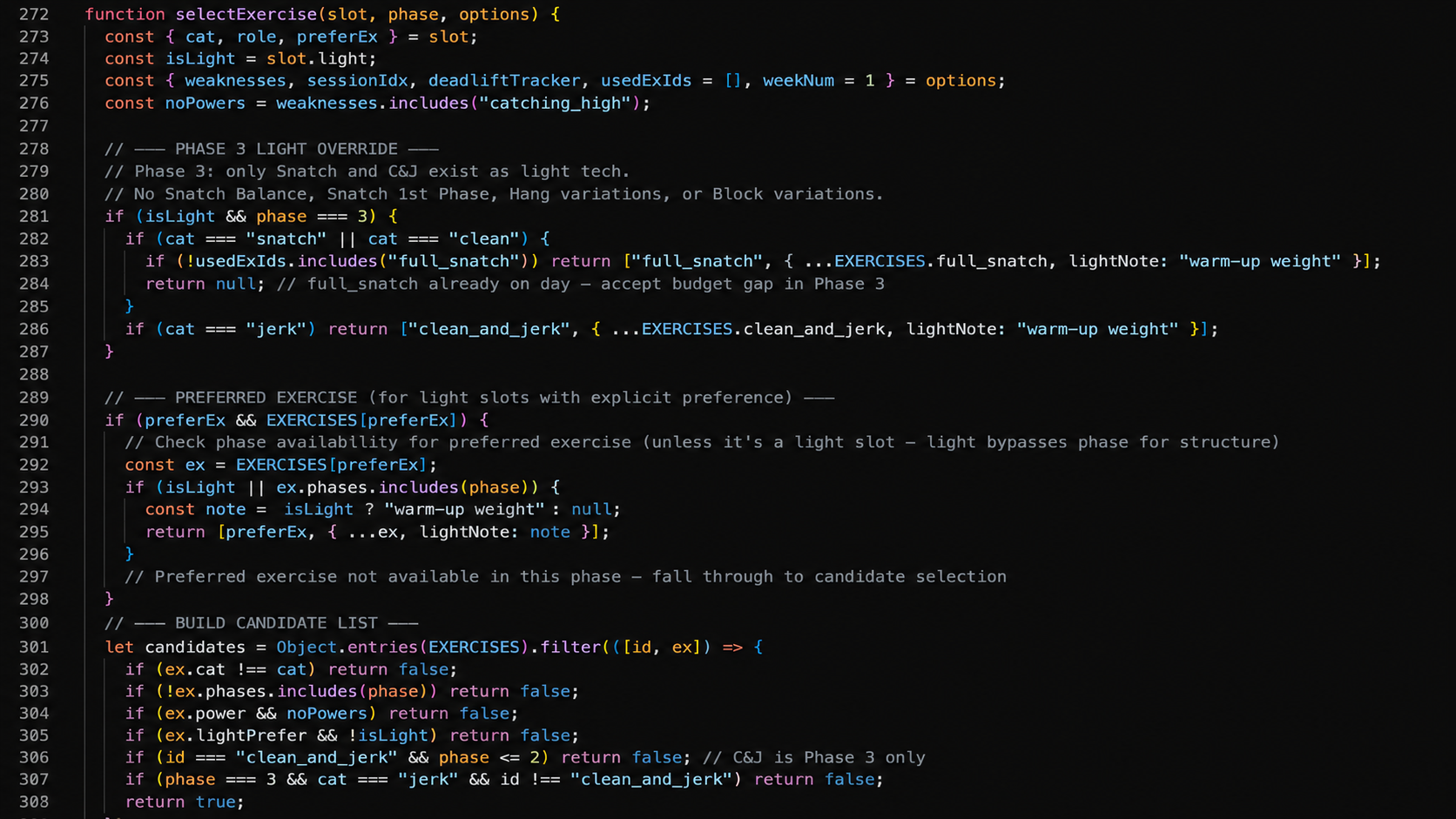
When the Zoom ended, I sat with my laptop and did the multiplication. Three durations, three frequencies, and the ratio and weakness branches sitting on top of them. One hundred and thirty-five distinct programmes. All follow the same undulating periodisation structure. All of which had to be sensible, and all of which had to be defensible.
What have I done to myself? Have I lost my mind?
One Algorithm, 135 Templates
Olympic weightlifting is a technique-heavy sport. The need for and the desire to perfect technique are among its pinnacles. Naturally, there are many ways that this is achieved and taught. I have been coached by people who disagreed with each other. No one is wrong; they are just different.
A human coach can watch a lift, feel that something is wrong, and change what they planned to do next. An algorithm cannot do that. It does not notice. It does not reconsider. It processes the inputs it was designed to receive and returns an output within the wall of limitations it was given. The same way, every time, and for everyone.
Let me show you a simple example. A five-day-a-week training template. Two lifters, both ticking the same box: five days. One has plenty of time but limited recovery capacity. Another could physically tolerate five sessions but has a demanding job and an unpredictable schedule. “Five days” tells the algorithm almost nothing about the lives those five days have to fit into.
Also, I had to build the system around a minimum commitment to make the periodisation work: eight weeks with no interruptions, three sessions a week, each 90 minutes. Anything much less, and the periodisation structure, the planned rise and fall of volume and intensity, would begin to break down. Then, the question arises. Who can actually achieve that? I mean… uninterrupted eight weeks? Someone with very few competing demands on their time, perhaps.
That said, I kept the requirement in place anyway. A programme that promises results in two rushed 45-minute sessions per week over 3 weeks is overly optimistic.
2 a.m. on Easter Monday
What I was doing was not manual programming, where you could just tweak one or two cells in a spreadsheet. This is a rule-based algorithm. One small change to one rule has a knock-on effect across all 135 templates. A quick 10-minute check turned into hours of work. Then days. Days became weeks. Change a rule, review the programmes. Reduce the number of variables; review again. Restart the server. Refresh the screen. Wait two minutes. Start again. And again.
By early April, my stress level was going through the roof. Nothing was working. My self-doubt was kicking in.
Are you building an exercise template in a sport where the coaches cannot agree on the basics without starting a war? Good luck with that.
People are going to judge you. You are on the wrong side.
Who wants to take advice from a 61-year-old amateur lifter whose PB is lighter than their warm-up weight?
What are you doing at 2 a.m. on Easter Monday, sitting alone with the laptop? Have you nothing better to do?
What depressed me the most was this. I was pouring time and energy into something I had never believed in. The one-click personalised programme is not real. It can never be. And even a skilled human coach, with the best intentions, is still a human being with a finite number of hours and a finite amount of attention to give each athlete. We all have a life outside the gym.
What Is a ‘Personalised’ Programme, Then?
An individualised training programme should be a process: constant trial and error, athlete and coach working together, homing in. It should never be delivered as an end product.
What I have built in this app is a process in which the algorithm generates a template to serve as a starting point. The template follows a periodised structure. The expectation is that coaches or athletes then tweak it to suit the individual. It is not perfect, but at least the logic behind it is transparent.
The app I had in mind was this: simple and easy to use, with some built-in educational content and a memory for the training logs that doesn’t disappear when you leave your coach or club. Anything else is a bonus.
The programme can be generated by using one of the templates or through an AI chatbot that can modify the template based on your input. The programme can also be created completely by hand. Alternatively, if you already have a programme, you can upload the file as a PDF, DOCX, or XLSX so that an AI can populate the workout card for each day for logging.
This is not the end of the process. I will keep refining the algorithm, adding small rules, and using better AI models as they come along. One step at a time, the algorithm-generated templates will become better. The intention is not for the app to remove the athlete or coach from the planning process, but to make the tedious parts of planning easier.
SmartLift and its programme generation are still a work in progress. If any of these ring a bell, come along and see what happens.
SmartLift is a tool, not a coaching platform.
Links:
Ultimate Weightlifting Program — Michaela Breeze
For the Love of Weightlifting — Cyril Martin